A review meeting is more than a routine check-in. Done right, this structured evaluation session boosts performance, realigns goals, and sparks motivation.
This post explores the nature of these meetings, how you should organize them, examples, and main types.
Also, you’ll discover how to make these sessions impactful and productive with the Krisp AI Meeting Assistant. Finally, you’ll reveal mistakes to avoid and what template to use.
What Is a Common Review Meeting?
A common review meeting is a structured gathering. Specifically, participants gather to assess progress, discuss challenges, and refine strategies to meet project goals.
Merriam-Webster defines “review” as a “general survey, critical evaluation.” So, leaders use these sessions to learn from past experiences, evaluate decisions, optimize future actions, and identify improvement areas.
What to call a review meeting? You can call it:
Evaluation meeting or session
Progress review
Follow-up meeting
Reporting session
Performance review, checkpoint, or assessment
Project check-in
Reflection meeting
Performance feedback session
Progress discussion
Reflection meeting
Checkpoint meeting
Process audit
Assessment conference
What Is a Formal Review Meeting?
Managers schedule a formal review session annually to evaluate employees’ performance over the entire year.
Specifically, managers use structured and agenda-driven official reviews to assess progress, identify challenges, and propose actions. Then, they produce a written report that goes into personnel files.
What Is the Purpose of a Review Session?
The primary objectives of an evaluation meeting are to:
Improve efficiency and improve overall performance optimization.
Example: In a software company’s quarterly review meeting, the project manager and teams assess progress on a new feature. Then, they address challenges like technical issues and delays.
Each team shares insights and adjusts timelines, with specific follow-up actions assigned. In the end, documented action items guide future phases, enhancing alignment and streamlining the project.
Review Meeting Vs. Other Meetings
Review meetings evaluate past performance, progress, and outcomes so teams can align with goals. Importantly, evaluation sessions:
Emphasize deeper, strategic assessment and planning
Analyze achievements
Address challenges in a structured manner.
Are typically formal and documented
Aim at accountability, decision-making, and refining strategies.
In contrast, other meetings, such as status updates or brainstorming sessions, prioritize:
Idea generation
Immediate problem-solving
Information sharing.
Review Meeting Vs. Meeting Review
A review meeting:
Occurs periodically
Assesses progress, performance, and alignment with goals.
Promotes accountability
Makes informed adjustments
Focuses on specific projects.
A meeting review:
Occurs after a meeting has ended
Evaluates meeting effectiveness
Checks if the team has met the objectives
Identifies improvements for future sessions.
Focuses on meeting quality.
What Are the Three Types of Review Meetings?
Here are three common types of review meetings with their agendas.
Sprint Review Meeting
A sprint review meeting is organized at the end of a sprint in Agile development. Agile project management methodology breaks projects into dynamic phases called “sprints.”
In this case, the Scrum team and stakeholders gather to review progress and adjust the product backlog. Specifically, the Scrum team members showcase completed work and ask for feedback. Scrum is a well-known Agile project management framework.
Agenda:
Review completed work
Gather stakeholder feedback
Update the product backlog
Discuss next sprint objectives
Performance Review Meetings
A performance review meeting evaluates an employee’s performance over a set period, identifying strengths and areas for improvement. As a result, it enables employees to receive feedback and set goals for development.
Agenda:
Review achievements and challenges
Discuss feedback on performance
Set goals for the next period
Outline a development plan
Project Review Meeting
A project review meeting assesses project progress, risks, and required course corrections. So, it allows meeting participants to maintain alignment with project goals and timelines.
Agenda:
Review project milestones and progress
Identify risks and challenges
Adjust timelines or tasks as needed
Assign follow-up actions
Bonus Types 1: Assembly Review Midweek Meeting
An assembly review midweek meeting is a quick check-in held midweek to review current tasks. This meeting helps to coordinate activities and address immediate needs.
Agenda:
Review progress on the current week’s tasks
Address immediate challenges
Re-align team on objectives
Set priorities for the rest of the week
Bonus Type 2: Institutional Review Board (IRB) Meeting
An institutional review board (IRB) committee reviews and approves research based on federal regulations and institutional policies. So, during an institutional review board meeting, members ensure that research studies safeguard participants’ rights and well-being.
Agenda:
Review proposed research studies
Assess ethical considerations and risks
Approve or request modifications to proposals
Document decisions and any follow-up requirements
How to Schedule a Review Meeting?
Here are steps to ensure a well-organized and effective meeting that encourages full participation and preparedness.
Clearly define the purpose of the meeting, e.g., performance review, project review, or sprint review. Additionally, communicate this purpose to participants so they understand why their attendance is valuable.
Identify who needs to attend, such as team members, stakeholders, or management, depending on the meeting’s focus.
Choose a date and time that accommodates all participants, factoring in time zones as needed. Besides, offer multiple options for easier scheduling.
Write a clear subject line and salutation like “Quarterly Project Review Meeting.” Also, include a friendly salutation. Introduce yourself if you haven’t met the participants yet.
Send Calendar Invites using a scheduling tool like Google Calendar or Outlook. Attach an agenda outlining key topics, objectives, and materials for review. Also, include video links for remote participants if necessary.
Ask for confirmation or reply in your message to be sure everyone is aware and prepared to attend.
Send reminders one day and one hour before the meeting to reinforce attendance and preparedness.
Who Should Attend a Successful Review Meeting?
Typically, team members, project leaders, relevant stakeholders, subject matter experts, and senior management (if necessary) attend review sessions.
Specifically, each participant brings unique insights, contributes feedback, and is accountable for follow-up actions. How?
Diverse perspectives help create a comprehensive review that results in a thorough evaluation and well-informed decision-making.
How Often Does a Review Meeting Occur?
Review meetings are often held annually or bi-annually. However. some companies organize these gatherings every three to six months to keep feedback timely and employees focused. Overall, the frequency depends on the nature of the meetings.
For instance, ongoing projects need more frequent reviews. However, long-term initiatives benefit from periodic check-ins to assess progress and adjust strategies as necessary.
To conduct effective virtual or hybrid meetings, you should pay attention to engagement strategies and technology.
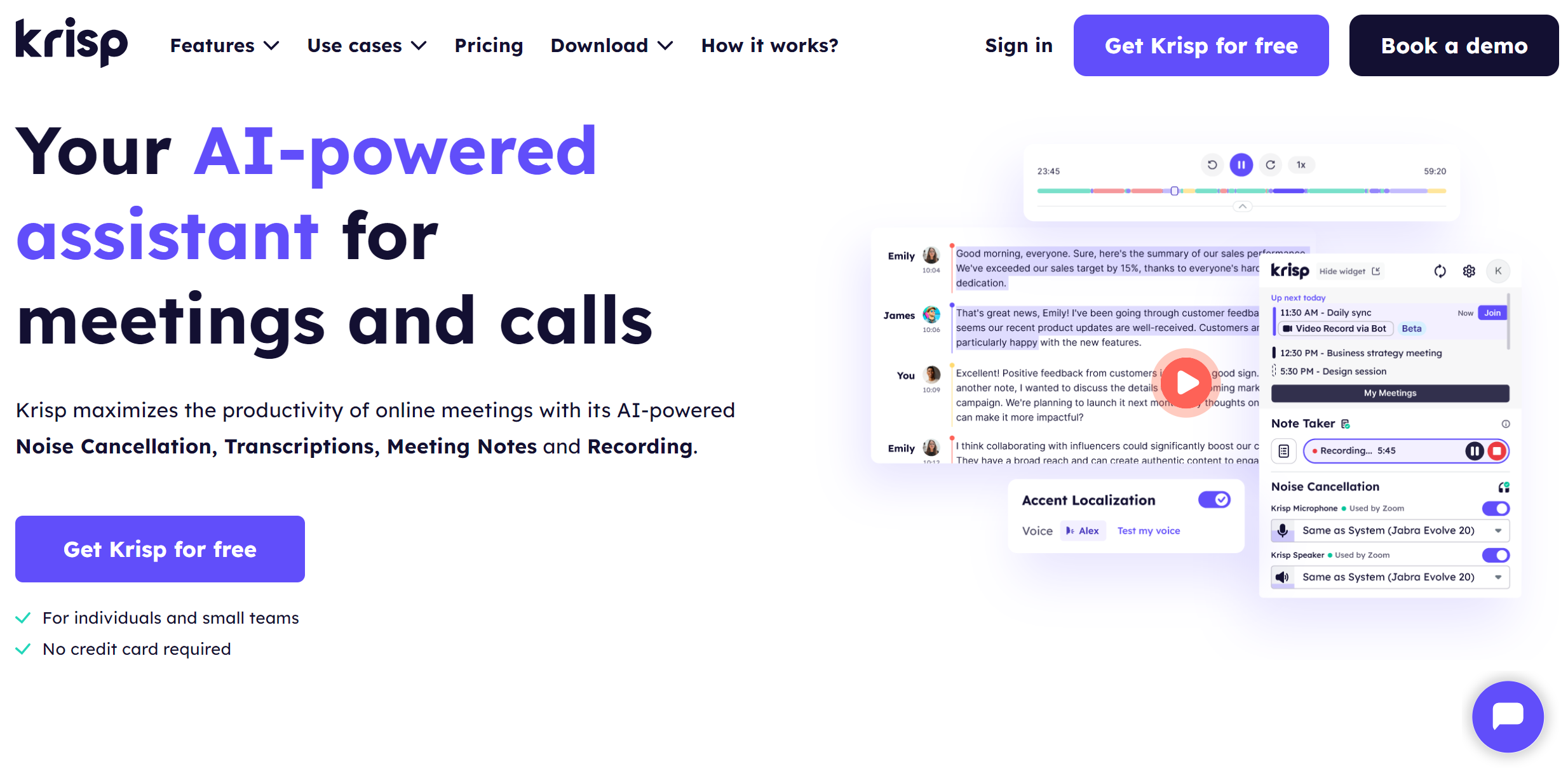
For instance, the Krisp AI Meeting Assistant takes virtual and hybrid review meetings to the next level through unmatched Noise Cancellation and meticulous Note Taking.
Example: Let’s take a software developer working on reducing bugs. Analyze metrics showing the code quality and work efficiency over the last quarter. Then, highlight specific improvements and challenges.
Establish clear goals.
Example: If your objective is to assess project leadership skills, outline participants’ progress. Then, discuss leadership qualities and set new goals for managing larger projects.
Prepare and share an agendain advance.
Example: A typical meeting agenda can include points like “Welcome and Opening Remarks” (5 minutes) and “Review Previous Goal and Action Items” (10 minutes). Find a template example at the end of the article.
Begin by greeting participants and setting a positive tone. Use virtual icebreakers to foster openness.
Example: Consider starting this way, “Good [morning/afternoon], everyone. Thank you for taking the time to join today’s review meeting. I’m glad we could all connect to discuss our recent progress and achievements…”
Follow proper team norms. Team norms are shared expectations and rules, such as open communication and mutual respect.
Example: Let’s take a marketing team member presenting campaign results. And others follow the norm of avoiding interruptions for a respectful and organized discussion.
Present feedback and observationson recent performance.
Example: You could start this way, “First, I want to recognize your dedication to consistently meeting your deadlines… One area we might focus on improving is…”
Use the SMART goal framework (Specific, Measurable, Achievable, Relevant, and Time-related).
Example: Let’s take a customer service representative aiming to boost customer satisfaction. Set a goal to improve their customer satisfaction score by 10% within the next quarter.
Recognize successes and discuss areas for growth.
Example: Consider starting this way, “Congratulations on the successful launch of the new product feature… One area for potential growth could be…”
Define goals to work toward by the following meeting.
Example: Let’s take a participant looking to build leadership skills. Set a goal to lead a small project and complete a relevant online course before the next review session.
As a result, the Krisp AI Meeting Assistant eliminates distractions from your online interactions and facilitates note taking and note making.
How Krisp’s AI Meeting Assistant Improves Meetings
Distraction elimination provides a noiseless environment for productive discussions. So you can focus on review and evaluation instead of getting annoyed. Did you know Krisp pioneered the world’s first AI-powered Voice Productivity software?
Meeting Recording with superb audio quality stores your virtual interactions so you won’t miss critical ideas and brainstorming. Revisit and review them later. Moreover, Krisp’s AI Meeting Assistant doesn’t need to join the calls to record them.
Transcription with exceptional accuracy and stellar speaker recognition automatically transcribes online discussions instead of you. Besides, you can upload a meeting recording to Krisp and get the transcription. This is handy for offline recordings.
Error-free Meeting Notes and Summaries give you critical takeaways meticulously so you can focus on the gist of discussions and idea generation. Then, you can make the necessary changes and include the data in a review meeting agenda template.
Krisp’s flagship Noise Cancellation technology is used on 200M+ devices, processing 80B+ minutes of conversations daily.
Krisp’s AI Meeting Assistant works on WinOS and MacOS and with any videoconferencing software, including Zoom, Goole Meet, and Microsoft Teams.
A review meeting is a structured session where team members evaluate progress and discuss achievements. Also, they address challenges and set future goals.
Specifically, a successful review session requires steps like creating an agenda, gathering feedback, and defining objectives.
Importantly, use the Krisp AI Meeting Assistant to make your meetings focused, productive, and aligned with goals.
Frequently Asked Questions
A meeting review is a reflection on a recent meeting. Specifically, it assesses effectiveness, identifies areas for improvement, and gathers feedback to enhance future meetings.
A monthly review meeting is a regular check-in to evaluate ongoing projects. Specifically, it tracks progress and addresses challenges, keeping team members aligned with short-term goals.
An annual review meeting is a yearly session focusing on evaluating long-term achievements. Namely, it sets new goals and reflects on overall performance to guide plans.
The 3 Cs of a meeting are Clarity, Collaboration, and Communication. They help make meetings focused and effectively convey key information among participants.
Gather relevant data and review previous action items. Additionally, set a clear agenda and outline goals for the discussion to enjoy a productive session.
Define the objectives of the meeting and identify participants. Besides, set a date and agenda and send calendar invites. Finally, prepare the necessary materials for an organized review session.
Politely request a review meeting by stating its purpose and suggesting potential dates. In addition, emphasize how valuable the meeting is for aligning on goals and addressing progress.