Krisp Voice AI is real-time voice infrastructure for call centers. It operates at the audio layer, inside the live call, processing voice as it happens. Noise eliminated. Accents converted. Language barriers removed with speech-to-speech translation. All in real time, within the existing call flow.
Today, we’re launching Voice Translation v3.
From speech-to-speech translation to enterprise-grade system
Voice Translation (VT) has been delivering real-time, bidirectional translation inside live calls since launch. The results in production speak for themselves:
| Healthcare deployment |
| 90% of multilingual calls completed end-to-end |
No interpreter needed |
| 96% overall translation accuracy |
Accuracy QA-scored across every call |
| Zero patient safety incidents |
In a live healthcare deployment with medical terminology, prescription names, and patient identifiers |
| 8 languages deployed in one workforce |
0 seconds interpreter wait time |
These numbers come from a national healthcare services provider supporting public health programs that serve millions of consumers. The highest-stakes environment we could test in.
In conversations like these, a wrong medication name, a misheard policy number, or a mistranslated disclosure carries real consequences. VT was built for exactly this kind of environment — where the details have to be right.
VT v3 builds on that foundation. Today, we are launching a set of capabilities that turn Voice Translation into a fully governed, quality-assured multilingual operations system, built for the most complex real-world scenarios.
Voice translation accuracy: benchmarked, not claimed
Everything in VT v3 starts with accuracy.
Voice Translation accuracy has been tested across 30 languages and 6 business domains, with 870 conversations evaluated through automated metrics, AI-based quality scoring, and independent bilingual human review. Translation Accuracy QA scores consistently land between 93 and 97 across all benchmarked languages.
The system ships with built-in domain vocabularies and dictionaries for finance, healthcare, insurance, retail, travel, and universal scenarios. Accuracy is strong from day one.
And it improves with use. Enterprises can add custom vocabulary for transcription accuracy and custom dictionaries for precise translation of domain-specific terms. Agents can submit suggestions directly from their app. Accuracy QA flags terms that should be added based on patterns it detects. Three input channels that continuously sharpen accuracy for each specific deployment.
For the full accuracy story with benchmarks, evaluation methodology, and language-by-language results, read our accuracy deep-dive.
Every call scored. Every call visible.
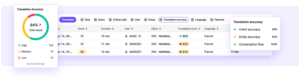
VT Accuracy QA scores 100% of translated calls across four dimensions: whether meaning was preserved, whether critical details survived, whether the conversation flowed naturally, and whether the output sounded professional. It measures the real-world impact of issues on the conversation, not just error counts. Supervisors get structured, full-call visibility into translation performance without manual review.

Live call audit gives admins real-time visibility into both sides of the translation. All four audio tracks (agent original, agent translated, customer original, customer translated) plus a live transcript. If something sounds off, admins can pinpoint whether it’s an agent issue or a translation issue and intervene accordingly.
Faster calls. Accurate every time.
Quick Phrases lets admins build a library of pre-written texts that agents play as translated speech during a live call.
For repetitive content like greetings, benefit explanations, transfer instructions, it allows to skip the speak-wait-translate cycle entirely. The agent hits play and moves on while the translated phrase is delivered to the customer. For regulated content, such as mandatory disclosures in healthcare, financial services, insurance, it delivers the message word-perfect in the customer’s language, every time.
Agents can customize phrases before playing them. Admin-controlled, agent-activated, works in any language VT supports.
The operational friction is gone
Language auto-selection removes language configuration from the agent’s workflow. The system switches VT to the correct language automatically at call start. No manual setup, no risk of starting a call in the wrong language.
Client IDs let BPOs and enterprises tag translated calls by end client for billing attribution, quality analytics, and operational tracking.
60+ production languages, with new additions including French (Canada), Spanish (US), Arabic (Egypt), Catalan, Galician, and Basque. Not just broader coverage, but more precise: locale-specific variants and regional languages that reflect how multilingual operations actually work.
Also available as a standalone voice translation API for developers building their own applications. Learn more here.

What this means for your operation
Voice Translation v3 turns multilingual support into operational infrastructure. Accuracy that’s benchmarked and continuously improving. Quality scoring on every call. Live visibility into the translation layer. Faster calls with guaranteed accuracy on critical content. Automatic language setup. Broader, more precise language coverage.
This is real-time voice translation built for the real world.
Book a demo → Explore what VT v3 can do for your operation.
FAQ
How accurate is Krisp's AI voice translation?
Krisp’s Voice Translation scores between 93-97% accuracy across 30 benchmarked languages, measured on live production calls with real accents, background noise, and domain-specific terminology — not clean studio recordings. Every call is scored automatically by Accuracy QA across four dimensions: meaning preservation, critical detail accuracy, conversational flow, and professional tone.
How does speech-to-speech translation work?
Speech-to-speech translation converts spoken audio in one language into spoken audio in another language in real time. The system processes the incoming audio stream, transcribes it, translates the text, and synthesizes natural-sounding speech in the target language — all within the live conversation. Unlike text translation, both input and output are audio, enabling natural two-way dialogue without interpreters.
What is translation quality scoring?
Translation quality scoring automatically evaluates every translated call across multiple dimensions — meaning preservation, critical detail accuracy, conversational flow, and professional tone. Krisp’s Accuracy QA scores 100% of translated calls, giving supervisors full visibility without manual review. It measures real-world impact on the conversation, not just error counts.
Why is it hard to understand certain accents in YouTube videos?
Accent differences change pronunciation, rhythm, and stress patterns. Your brain must decode these variations before processing meaning, increasing cognitive load—especially in fast or technical content where there is little time to adapt.