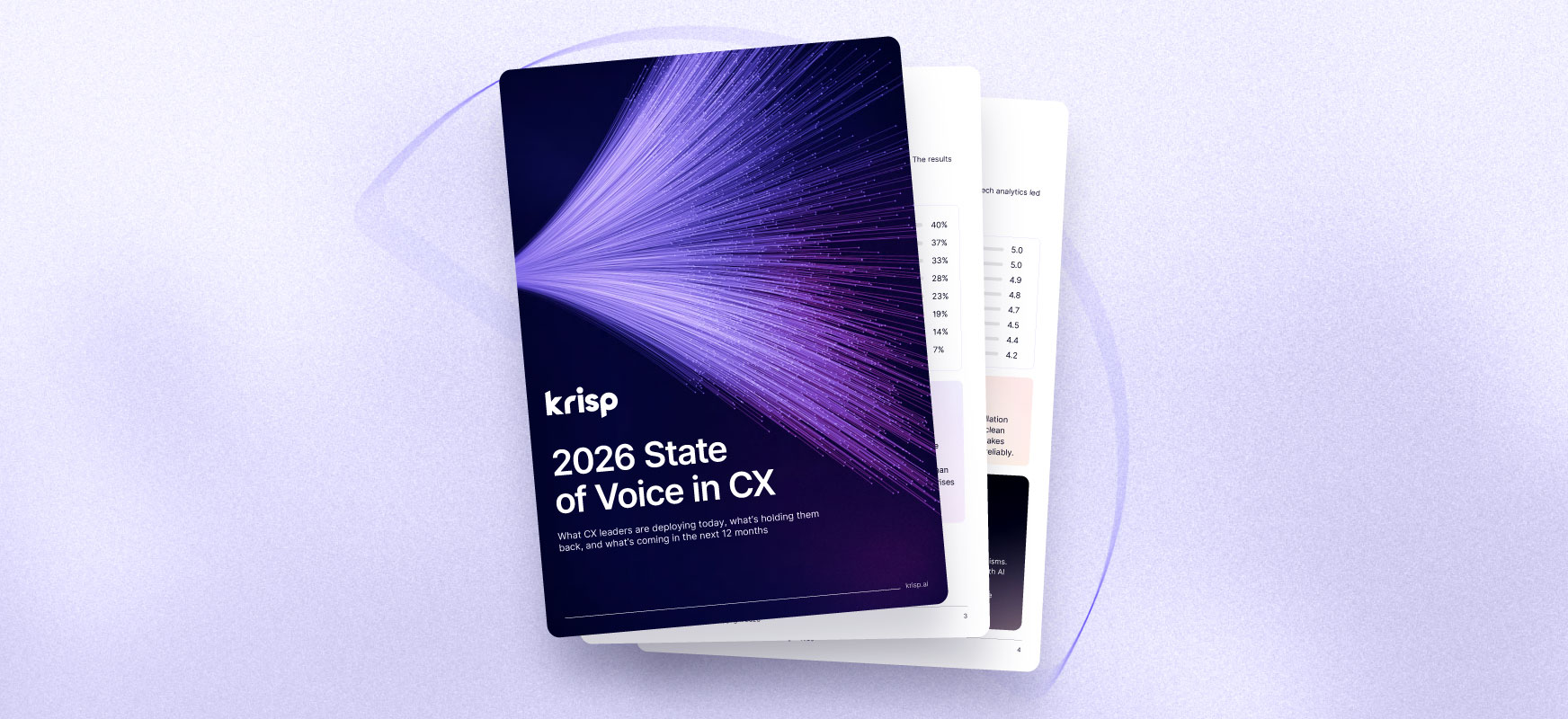
Krisp’s 2026 State of Voice in CX captures how 815 CX leaders across 12 countries are approaching voice technology, staffing, budgets, and global service delivery.
The findings show a market moving quickly from evaluation to implementation.
Talent and language remain the biggest barriers. Hiring agents in the right regions and languages was the top challenge, cited by 40% of respondents. The cost of supporting multiple languages followed at 37%, while technology integration ranked much lower at 14%.
CX leaders are prioritizing immediate operational impact. Agent Assist and Speech Analytics received the highest impact scores at 5.0 out of 6, followed by real-time coaching at 4.9. This creates one of the report’s most interesting tensions: language is the leading barrier, while tools that make current teams faster and more effective are seen as having the greatest near-term impact.
Adoption is accelerating across every major category. Sixty percent plan to adopt AI Voice Translation within 6 to 12 months, up from 36% in 2025. Current and planned adoption of Accent Conversion reached 61%, while Speech Analytics reached 80%.
Budgets and buying channels have yet to catch up. More than half of respondents allocate over 50% of their voice budgets to onshore agents. Meanwhile, CCaaS vendors have overtaken BPOs as the preferred delivery channel for several major voice AI capabilities.
Together, the findings point to a new operating phase for voice CX. Enterprises are using AI to strengthen existing teams while rethinking how they staff, fund, and scale service across markets.
Explore the full report for the complete findings and year-over-year analysis.