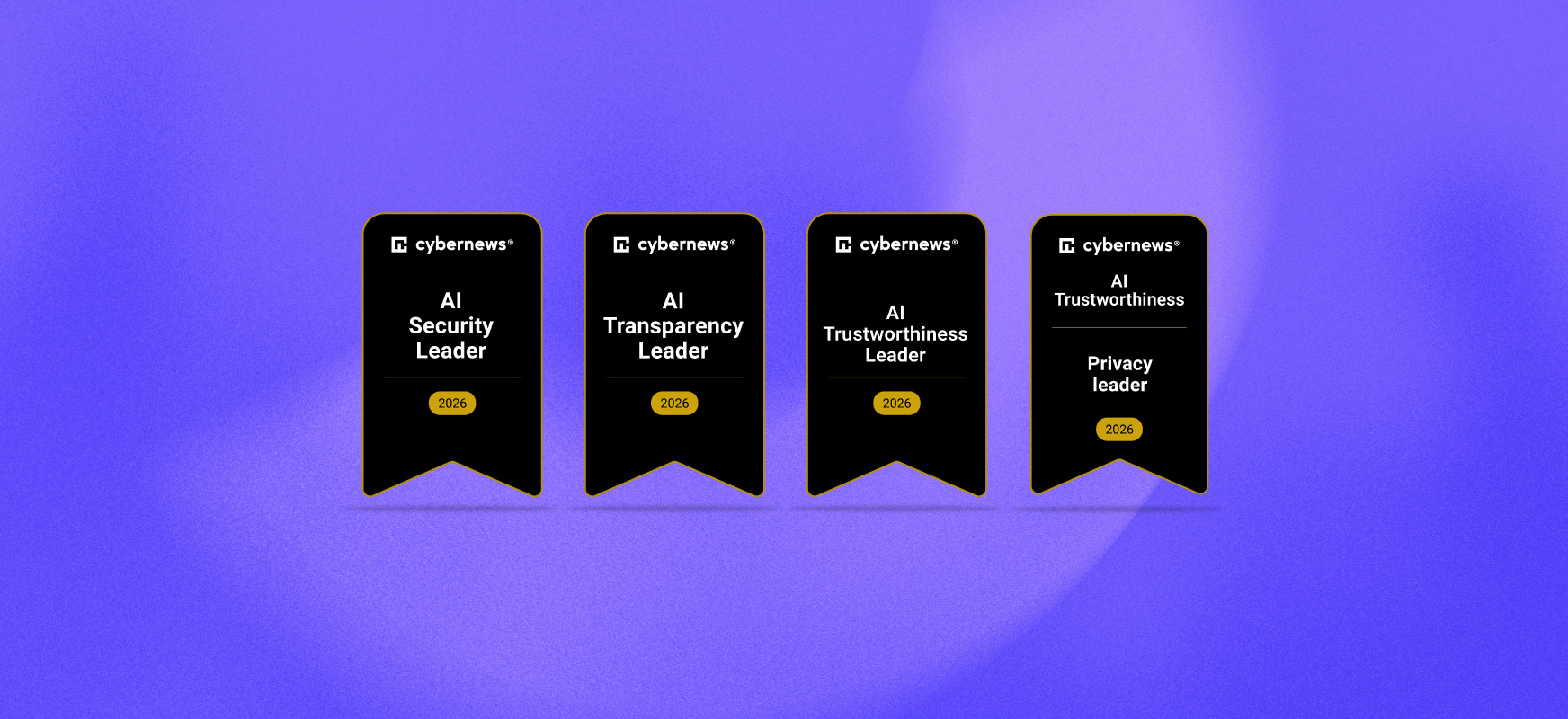
Krisp has been ranked #2 out of 500 AI companies evaluated by Cybernews in its 2026 AI Trustworthiness Ranking, earning an overall score of 97/100.
Cybernews scored Krisp 100/100 across:
- Security
- Data Privacy
- Organizational Transparency
The average company scored 65/100 overall, and just 32/100 for security.
As AI becomes embedded in more of the systems people use every day, AI trustworthiness can’t be treated as a feature or a compliance exercise. It has to be built into how technology is designed, how data is handled, and how clearly companies explain those choices.
That standard applies across AI. In Voice AI, the responsibility becomes especially immediate. Voice AI operates inside live conversations, where people exchange ideas, decisions, identities, and sensitive information in real time. The closer AI gets to human communication, the higher the standard for protecting it has to be.
Unlike many AI applications where users deliberately submit a prompt or upload a file, Voice AI can operate continuously inside live conversations. That makes minimizing how much voice data leaves the endpoint, and being explicit about when it does, an important part of designing trustworthy Voice AI.
AI Trustworthiness can’t be a promise
AI increasingly operates inside the digital interactions where people work, communicate, make decisions, and exchange sensitive information.
They can contain sensitive personal, business, and operational information.
That means security, privacy, and transparency have to be architectural decisions, not language added later to a trust page.
For us, being a trustworthy AI company means making deliberate choices about what data is needed, where it goes, who can access it, how it is protected, and what customers and users can verify for themselves.
Security is built into how Krisp works
Security has always been part of how Krisp builds.
You can see that in architectural decisions across our products: Noise Cancellation and Accent Conversion process audio on-device; Agent Copilot generates transcripts locally before cloud-based summarization; PII can be redacted before data leaves the endpoint; and when capabilities like Voice Translation require cloud processing, we minimize what is transmitted and do not store the audio.
It shapes product architecture, data handling, infrastructure, and the standards we set for ourselves as the company grows. Not as a layer added at the end, but as a core part of how decisions get made.
The safest data is the data you don’t expose
One of the most important security decisions happens before encryption, access controls, or monitoring enter the picture: does the data need to leave the endpoint at all?
Krisp processes core Voice AI capabilities directly on the end user’s device. Noise Cancellation and Accent Conversion process audio locally, so voice audio does not need to leave the user’s machine. For Agent Copilot, transcription happens on-device, with the transcript sent to Krisp’s secure cloud infrastructure when AI summarization is required. When PII redaction is enabled, personally identifiable information is removed on-device before the transcript moves to the next stage of processing.
That matters because every additional system that touches data creates another point that has to be secured. Processing at the edge reduces unnecessary data movement and limits exposure before additional controls such as encryption, access management, and monitoring are even required.
For Accent Conversion, that principle is concrete. It doesn’t require voice enrollment, doesn’t store voice embeddings, and doesn’t save personal voice data on the device or in the cloud. By reducing the sensitive data we create and retain in the first place, we reduce the amount of data that ever needs to be protected.
We use on-device processing where the product architecture allows it. Where a feature requires cloud processing/storage, we disclose that and apply appropriate protections. Where data does need to reach Krisp infrastructure, we protect data in transit using TLS 1.2+ and encrypt customer data at rest with AES-256.
For Meeting Assistant, for example, Transcript-only mode can transcribe audio entirely on-device or send it to Krisp servers for transcription and immediate deletion, depending on the language and settings. If Recording or Note Taker is enabled, recordings and meeting data may be stored in the cloud to provide those services.
The point is not to force everything local. It’s to minimize data movement where we can, and be explicit about when and why cloud processing is required.
Security starts with architecture.
Security has to move as fast as AI
AI development moves quickly, and the security model behind trustworthy AI has to move just as fast.
Passing an audit isn’t enough, and, for the record, neither is earning an AI trustworthiness ranking.
Security has to be continuous. At Krisp, that means testing our systems and products for vulnerabilities, continuously monitoring our environment, tightly controlling access to production systems and customer data, and regularly reviewing and improving our security controls as our products and the threat landscape evolve.
Our security program combines preventative controls with continuous monitoring and independent validation. Access to sensitive systems and data is restricted based on business need, data is encrypted in transit and at rest, and our security posture is independently assessed through programs including SOC 2 Type II and PCI DSS.
But certifications should validate the work and never become a substitute for it.
Transparency is part of security
For Krisp, transparency means documenting not only the controls we have, but how individual products handle data. Customers can see which capabilities process audio on-device, which require cloud processing, when data is stored, what security controls protect it, and which subprocessors are involved.
AI companies are asking people and businesses to trust increasingly powerful technology with increasingly sensitive data.
That trust should come with evidence.
Customers and users should be able to understand what happens to their data, what controls exist, which third parties are involved, and what supports a company’s security and privacy claims.
Cybernews found that 63% of the AI companies it evaluated did not clearly disclose whether user data was used for AI model training, while 65% did not clearly disclose how long user data was retained.
That’s exactly the kind of ambiguity a trustworthy AI company should eliminate. Users should be able to understand whether their data is stored, how long it is retained, whether it is used to improve or train AI models, and which systems or third parties process it.
Learn more about Krisp’s approach to transparency in our Trust Center
Krisp received 100/100 for Data Privacy and 100/100 for Organizational Transparency in the AI Trustworthiness Rankings.
The principle behind those scores is simple: people shouldn’t have to guess what happens to their data.
“Trust in AI has to be demonstrated, not claimed,” said Arthur Soghomonyan, Senior Director of Security at Krisp. “The challenge now goes beyond protecting the data itself. As synthetic voice gets harder to distinguish from human voice, identity and authenticity become part of the security model. We have to build for that reality now, not after the threat catches up. Independent assessments like this ranking are meaningful validation, but security isn’t something you complete once. Our products, the threats, and the controls protecting them all have to keep moving.”
As Voice AI becomes more capable, security will increasingly extend beyond protecting confidentiality. Identity, authenticity, deepfake detection, and whether people can trust the voice on the other side of a conversation are becoming part of the Voice AI security model.
“AI is going to touch almost every part of how we work and communicate. The companies that lead this next era won’t just build the most capable technology,” said Davit Baghdasaryan, Co-Founder and CEO of Krisp. “They’ll build technology people can trust at scale. Ranking #2 out of 500 AI companies tells me the choices we’ve made from the beginning matter. But this is still the beginning. Trust will become one of the defining competitive advantages in AI.”
This recognition validates a principle that has shaped how we build: better AI doesn’t just need to perform well. It needs to earn trust, and keep earning it.
See the full Cybernews AI Trustworthiness Ranking
FAQs
-
What is the AI Trustworthiness Ranking?
The AI Trustworthiness Ranking is an independent evaluation by Cybernews that scores 500 AI companies from 36 countries on how much users can trust them. Each company gets an overall score from 0 to 100 based on publicly verifiable signals, such as privacy policies, security documentation, certifications, and public reviews. In the 2026 AI trustworthiness ranking, Krisp placed #2 with a score of 97/100.
-
What are the key evaluation pillars?
The ranking scores AI trustworthiness across four weighted pillars: security, data privacy, organizational transparency, and public perception. Security looks at controls and certifications, data privacy at how user data is handled and disclosed, organizational transparency at how openly a company shares who it is and how it operates, and public perception at user reviews and reputation. Krisp scored 100/100 in security, data privacy, and organizational transparency.
-
How often is the AI Trustworthiness Ranking updated?
Cybernews updates the AI Trustworthiness Ranking every year. Scores and badges are tied to the year they were earned.