Most contact center quality programs are built on a structural compromise: teams can only review a small fraction of calls, so they sample, hope the sample is representative, and manage performance from there.
That compromise shapes everything downstream. Coaching is based on the calls that happened to be selected. Compliance issues are discovered in scheduled audits, often weeks after they occurred. Performance problems become entrenched patterns before anyone identifies them as patterns.
Today, with Krisp Speech Analytics, that compromise is no longer necessary.
The numbers behind the gap
Most QA programs review less than 2% of calls manually.¹ At that coverage level, 98 out of every 100 calls happen without any structured oversight. No score, no summary, no compliance check, no coaching flag.
There is also an accuracy problem. Manual scoring is inherently variable — accuracy depends on the reviewer and tends to top out around 70%.¹ Automated scoring applies identical criteria every time, delivering consistent 90% or higher.
The financial case for fixing this is also clear. Shifting QA from manual sampling to automation can deliver more than 50% reduction in QA costs alongside a 25 to 30% improvement in agent efficiency.¹
Krisp Speech Analytics
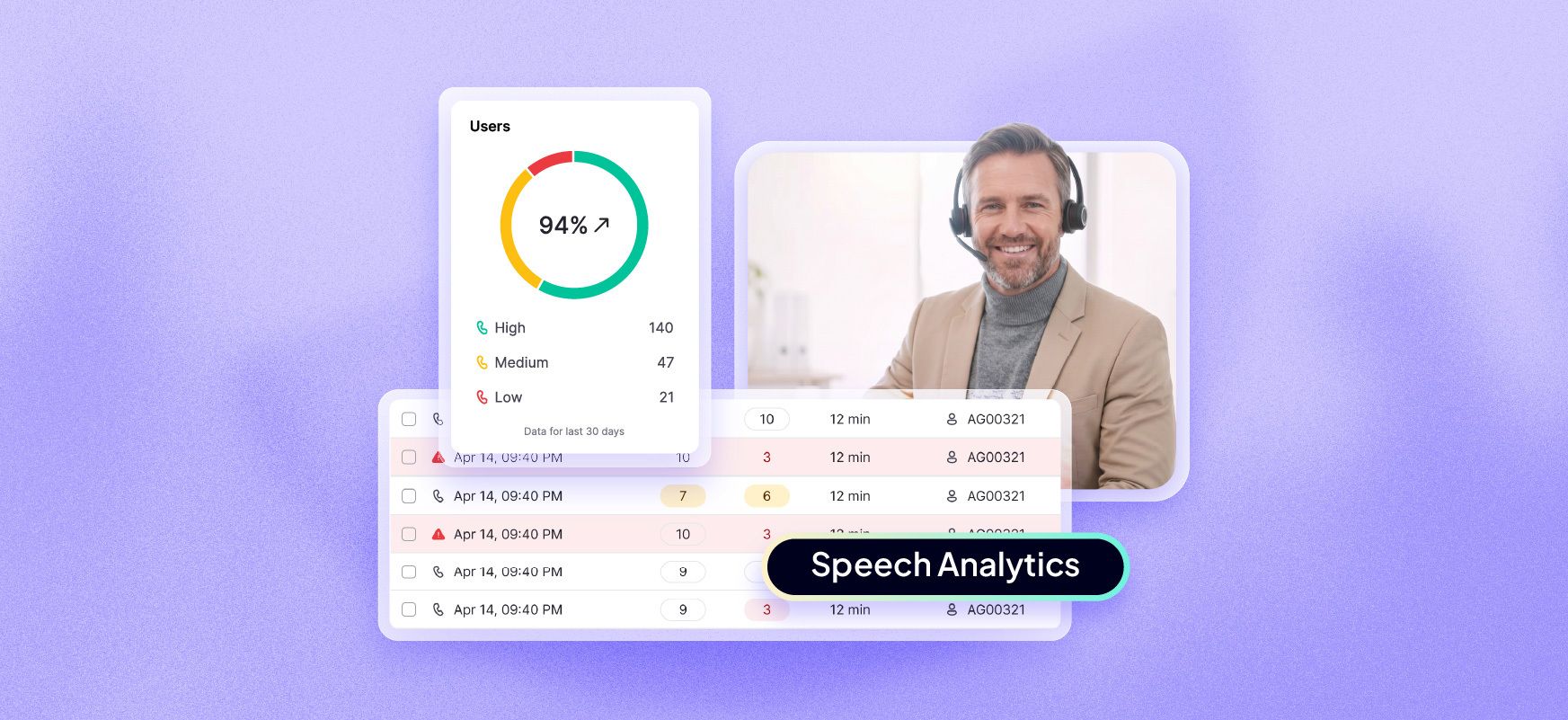
Krisp Speech Analytics automatically analyzes every call immediately after it ends. Every conversation becomes structured data, without anyone having to pull a recording, listen to it, or score it manually.
The foundation is a complete record of every call: transcript, recording (if enabled), and a searchable, timestamped log of events — all accessible in the admin portal. Call Scoring, Performance Monitoring, and Compliance Monitoring all operate on that same layer.
Call Scoring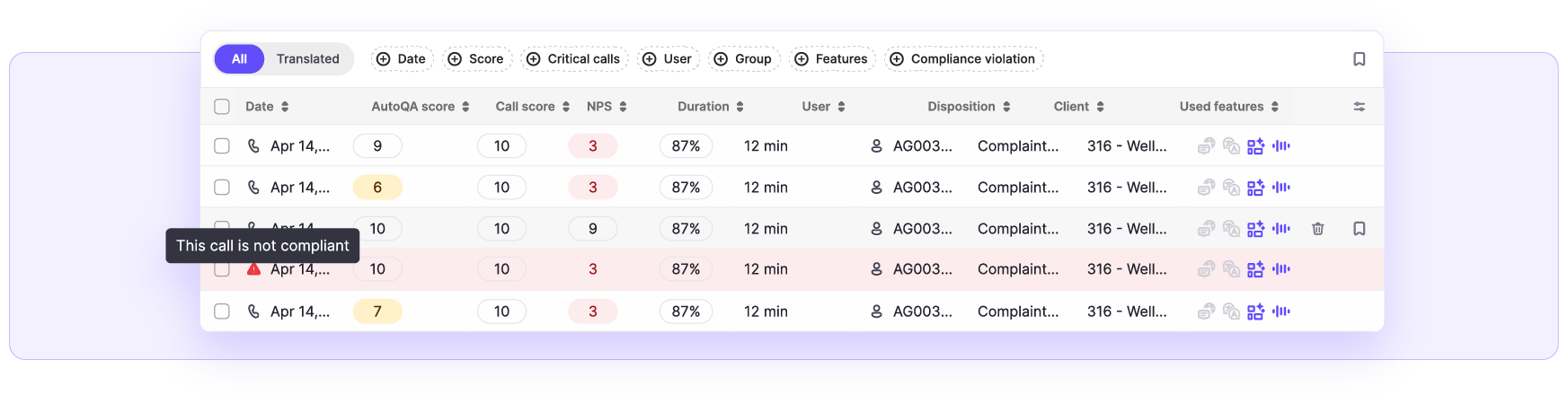
Each call is scored automatically against the team’s own quality criteria. Teams define the dimensions, the weighting, and the pass thresholds. Krisp provides a default set covering call opening, active listening, tone and professionalism, problem solving, and call closing — each can be adjusted or replaced entirely.
QA reviewers can drill into any call to understand not just the score but the reasoning behind it. Automated scoring handles the coverage; reviewers apply their judgment where it matters.
Teams can also run structured QA scorecard evaluations: a defined set of Yes/No questions applied to every call, with auto-generated justifications from the transcript. Call dispositions are assigned automatically from each transcript, giving operations teams consistent categorization data across every call for reporting and analysis.
What this gives QA teams:
- Every call scored against consistent, team-defined criteria
- Scorecard results with per-question justifications from the call
- Score, transcript, summary, and recording in one view
Performance Monitoring
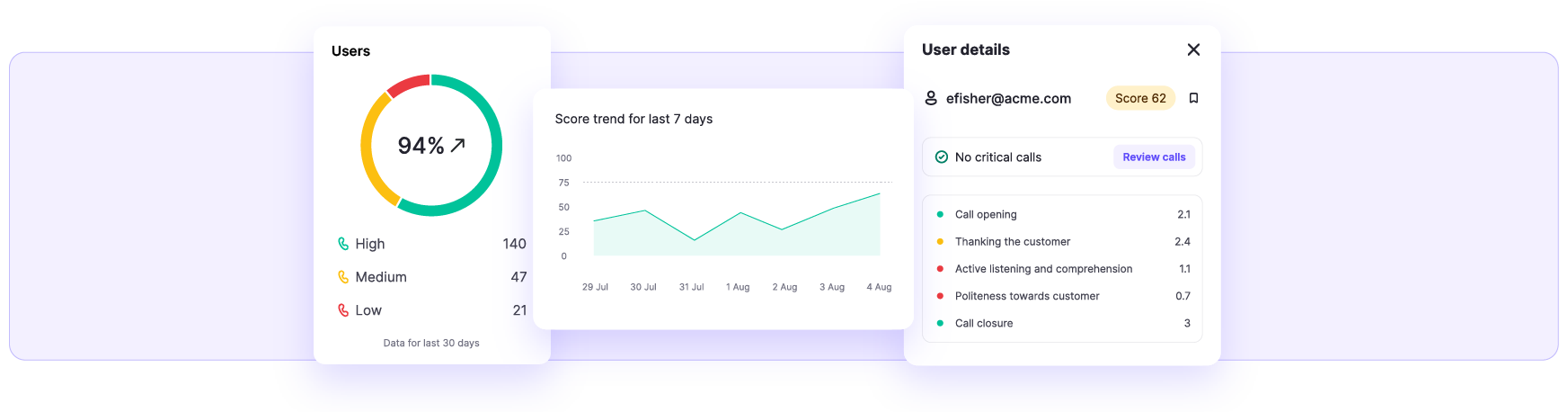 When every call is scored, performance becomes visible at a different resolution. Supervisors can track quality trends by agent, team, and time period across the full call volume, not a sample. Filtering and drill-down make it possible to move from a trend view to the specific calls driving it.
What this gives operations leaders:
- Trends by agent, team, and time period across every call
- Drill from a trend view to the individual calls behind it
- Coaching grounded in patterns, not spot-check impressions
Compliance Monitoring
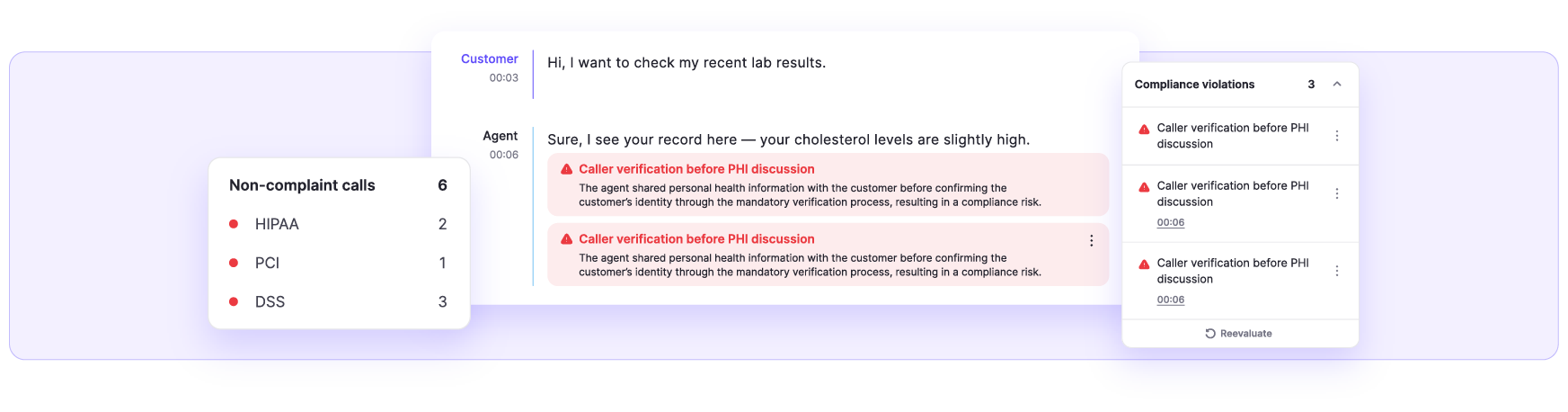
Compliance rules are applied to every call automatically after it ends. When a potential violation is detected, it is flagged with the specific transcript moment where it occurred — so compliance teams can review with full context rather than trying to piece together what happened weeks later in a scheduled audit.
Krisp provides a default rule set covering the most common risk categories, including identity verification, payment card handling, and unauthorized transactions. Every rule can be modified, and any number of custom rules can be added with no limit.
What this gives compliance teams:
- Every call automatically checked against team-tailored compliance rules
- Each flag linked to the exact call moment
- Compliance issues visible the same day they occur, not in the next audit cycle
Built into the voice layer, not on top of it
Already in the call. Krisp runs on the agent’s device, as a layer between the headset and any softphone. This is the same layer where noise cancellation and accent conversion run — the same layer where both the agent’s voice and the caller’s voice are accessible. Speech Analytics is built on that same layer. There is no separate recording infrastructure to stand up, no CCaaS integration to complete.
No CCaaS integration required. Krisp installs on agent devices and works across all CCaaS environments. Most AutoQA platforms require per-platform integrations that take months. Krisp teams are typically live within a week.
Secure by design. PII is redacted before any cloud processing. Scoring, summaries, and analytics run on redacted transcripts only. Data retention is fully configurable, and Krisp is SOC 2 Type II certified, HIPAA and GDPR compliant, and PCI-DSS certified.
Manual QA vs Krisp Speech Analytics
|
Manual QA |
Krisp Speech Analytics |
| Call coverage |
~2% sampled |
100% of calls, immediately post-call |
| Scoring consistency |
Varies by reviewer |
Identical criteria, every call |
| Scoring accuracy |
Up to ~70%, varies by reviewer |
Consistent 90%+, same criteria every time |
| Compliance detection |
Periodic audits, after the fact |
Flagged post-call on every call |
| Trend visibility |
Based on sampled calls |
Across every call, not a sample |
| CCaaS integration |
Not required |
Not required |
| Time to live |
Ongoing manual process |
Live within a week |
From 2% to 100%
Manual QA was the right approach when there was no alternative. It produced useful signal from a manageable workload. But at the scale contact centers operate today, sampling is not a methodology. It is a constraint disguised as one.
Speech Analytics removes the constraint. Every call scored. Every compliance event flagged. Every coaching opportunity visible. The QA team’s time shifts from reviewing calls to acting on what the reviews surface.
Book a demo to see Speech Analytics in your environment
Read the full launch announcement: Introducing Krisp Voice Security and Speech Analytics
Read about Voice Security: Voice fraud is not a future problem. It is happening now.
¹ McKinsey & Company, “AI mastery in customer care: Raising the bar for quality assurance,” July 2024; COPC Inc., “AI Quality Monitoring in Contact Centers,” June 2026.