Accents are one of the first things we notice when someone speaks. Within a few seconds, you may recognize where a person is from or at least that they sound different from you. This leads many people to ask why do people have different accents, even when they speak the same language.
In linguistics, an accent refers to pronunciation patterns: how sounds are formed, where stress falls, and how speech flows. Accents are not errors or personal choices. They are the result of accent formation shaped by geography, social interaction, and language learning. Importantly, everyone has an accent, including speakers who believe they speak “neutral” or “standard” English.
So where do accents come from, and how do accents develop over time? The answer lies in a combination of early childhood learning, exposure to local speech, historical sound changes, and social identity. From regional accents to subtle phonetic variation within the same city, accent differences follow clear linguistic principles.
This article explains how accents form, why they change across generations, and how modern technology—including real-time AI—is beginning to improve accent understanding without erasing identity.
Key takeaways
Accents form through early learning and community exposure.
Geography, migration, and social identity shape how accents differ and change.
AI is moving beyond transcription toward real-time accent understanding in conversation.
What Is an Accent?
In linguistics, an accent includes how sounds are articulated, where stress falls, and how rhythm and intonation shape spoken language. In simple terms, it’s the pronunciation layer of a language.
According to The New Oxford American Dictionary (2nd ed., Oxford University Press), an accent is a way of pronouncing a language that is distinctive to a country, region, social class, or individual. In sociolinguistics, accents are identified through systematic differences in pronunciation, not through grammar or vocabulary.
A common source of confusion is the distinction between accent vs. dialect.
Accent: how a language is pronounced
Dialect: pronunciation plus grammar and vocabulary
As sociolinguist Peter Trudgill explains, two speakers may share the same dialect but have different accents if their pronunciation differs. Conversely, speakers can sound similar while using different grammatical forms. This distinction is central to sociolinguistics and dialectology.
From a phonetic perspective, accents are built from several interacting components:
Pronunciation of consonants and vowels
Intonation, or pitch movement across phrases
Stress patterns, determining which syllables are emphasized
Rhythm, the timing and pacing of speech
Phonetician Peter Ladefoged emphasized that these features are systematic and learnable. Together, they form coherent sound patterns within speech communities. Well-known examples include rhoticity (pronouncing or dropping “r” sounds), t-glottalization, and consistent vowel shifts.
A core linguistic principle is that everyone has an accent. There is no scientifically neutral or accent-free way of speaking. What is often labeled “standard” pronunciation reflects social convention and institutional power. To understand why these differences exist at all, it is necessary to look at where accents come from and how pronunciation patterns form, spread, and stabilize within communities over time.
Where Do Accents Come From?
Accents form when communities develop their own “default settings” for pronunciation—and those defaults shift as people move, mix, and pass speech patterns to the next generation. Four forces show up again and again: geography, settlement history, language contact, and long-term sound change.
Geographic isolation and accent variation
One of the main reasons accents develop is geographic isolation. When groups of people live apart from each other, their speech slowly changes in different ways. Over time, small pronunciation differences add up and become stable regional accents.
Before modern travel and mass media, most people spoke mainly with those around them. This allowed local pronunciation patterns to settle and pass from one generation to the next. That is why accents often shift gradually from place to place rather than changing suddenly.
Settlement patterns and founder effects
Accents are also shaped by settlement patterns. Linguists describe this using the concept of founder effects. When a small group of speakers establishes a new community, their way of speaking strongly influences the local accent.
If those early settlers share certain pronunciation traits, those traits can remain even if they later disappear elsewhere. This helps explain why accents in newly settled regions often differ from accents in the original source areas.
Language contact and accent influence
Another major factor in accent formation is language contact. When speakers of different languages interact, pronunciation patterns can transfer from one language to another.
Linguists describe this using two key terms:
Substrate influence: features from a speaker’s first language that remain after switching to a new language
Superstrate influence: features introduced by a socially or politically dominant language
These influences can affect vowel quality, consonant timing, and intonation. As a result, accents often reflect migration history, bilingualism, and long-term language contact.
Historical sound changes
Accents also develop through historical sound change. Languages naturally change over time, and pronunciation shifts often spread unevenly across regions.
A well-known example is the Great Vowel Shift in English, which took place between the 15th and 18th centuries. During this period, long vowel sounds changed systematically. Not all communities adopted these changes in the same way, which contributed to lasting accent differences.
Rhotic and non-rhotic accents
A clear example of accent variation is the difference between rhotic and non-rhotic accents. Rhotic accents pronounce the “r” sound in words like car or hard. Non-rhotic accents drop this sound unless it is followed by a vowel.
This distinction helps explain differences between British English, American English, and Australian English, where historical sound changes spread differently across regions.
This difference developed through historical sound loss, regional transmission, and social prestige—not personal preference. It shows how accent features emerge and stabilize over time.
Overall, accents form through predictable linguistic processes. Geography, settlement history, language contact, and sound change work together to produce the accent diversity we hear today.
Why Do People Have Different Accents?
People have different accents because we learn pronunciation from our communities, and speech patterns change over time. Geography, migration, language contact, and social identity shape how sounds and rhythm evolve across regions and groups. Accents are learned early, reinforced socially, and passed across generations.
Biological and developmental factors
Accent development begins in early childhood. One key concept is the critical period hypothesis, which suggests that there is a biologically optimal window for acquiring the sound system of a language. During this period, children are especially sensitive to speech sounds and can learn fine phonetic distinctions with ease.
As children acquire their first language, they learn a specific phoneme inventory—the set of sounds that are meaningful in their linguistic environment. Sounds that are not used locally become harder to perceive and produce later in life. This is why adults often retain a foreign accent when learning a new language, even if they achieve high fluency.
Importantly, children do not simply copy their parents’ accents. Instead, they acquire the local accent of their peer group and wider community. Research consistently shows that pronunciation aligns more closely with the speech of classmates and social networks than with family members alone. This explains how accents remain stable within regions even as populations change.
Early learning explains how accents form in individuals. Social life explains why they persist.
Social factors and accent variation
Accents are powerful social signals. They communicate information about group membership, identity, and belonging. Speakers often—consciously or unconsciously—adjust their pronunciation to align with people they identify with.
This process is described by accommodation theory, which explains how speakers modify their speech depending on social context. People may converge toward the accent of a group they want to affiliate with, or diverge from accents they perceive as socially distant. Over time, these small adjustments reinforce shared accent norms within groups.
Social class and prestige also influence accent differences. Certain pronunciation features become associated with education, authority, or social status. Others may be linked to local identity or resistance to standardization. These associations shape how accents are evaluated and transmitted, even though all accents are linguistically equal.
Also, dense, close-knit networks tend to preserve local accent features. More open networks, common in urban areas, allow new pronunciation patterns to spread more quickly. This helps explain why cities often show rapid accent change while rural accents remain more stable.
Linguistic mechanisms behind accent differences
At a structural level, accent differences arise through phonological variation and change. Languages allow multiple ways of realizing the same sounds, and these variants compete over time.
One common mechanism is vowel shifts, where vowel pronunciations move gradually within the vowel space. These shifts rarely affect all regions equally, leading to clear accent differences. Consonant variation, such as changes in “r” pronunciation or consonant weakening, follows similar patterns.
Accents also differ in prosody, including rhythm, stress, and intonation. Some accents rely more on stress timing, others on syllable timing. Pitch movement and sentence melody can vary widely, contributing to why accents sound distinct even when individual sounds are similar.
Taken together, these biological, social, and linguistic forces explain why accent differences are so persistent. Accents are not deviations from a norm. They are the natural outcome of how humans learn language, interact socially, and transmit speech patterns across generations.
How Accents Evolve and Change
Accents change slowly—but constantly—as each generation reshapes what it inherits. Accent evolution is a core part of linguistic variation, showing how pronunciation changes across generations rather than within individual lifetimes.
Generational language change
Most accent change happens between generations, not within them. Children acquire the speech patterns they hear most often, but they do not reproduce them perfectly. Small differences in pronunciation accumulate over time, leading to noticeable shifts in accent features. Once these changes spread through a peer group, they can become stable markers of a new generation’s speech.
This process explains why older and younger speakers in the same region often sound different, even when they share the same social background.
Urban and rural accent patterns
Accent change tends to move faster in urban areas than in rural ones. Cities bring together speakers from diverse linguistic backgrounds, increasing exposure to variation. This creates more opportunities for new pronunciation patterns to emerge and spread.
Rural communities, by contrast, often have denser social networks and less population turnover. These conditions support accent stability, allowing older features to persist longer. This urban–rural contrast is a well-documented pattern in sociolinguistics.
Media influence and accent leveling
Mass media and digital communication have introduced new forces into accent evolution. Increased exposure to widely broadcast accents can lead to accent leveling, where strong local features weaken over time. This does not eliminate accents, but it can reduce extreme regional differences.
Importantly, media influence is indirect. People do not usually adopt accents simply by watching television. Instead, media exposure interacts with local social norms, reinforcing some features while diminishing others.
Migration and accent convergence
Migration plays a major role in how accents change. When speakers from different regions interact regularly, accents may converge, with shared features becoming more common. In other cases, accents may diverge, especially when groups emphasize linguistic differences to maintain identity.
These outcomes depend on social integration, power dynamics, and network structure rather than contact alone.
Modern influences: globalization and the internet
Globalization and online communication have increased contact across regions and languages. The internet exposes speakers to a wider range of accents than ever before. However, this has not produced a single global accent. Instead, it has accelerated linguistic variation, creating new hybrid patterns alongside traditional ones.
Online communities can also accelerate change by spreading features quickly—especially among younger speakers—while local identity still shapes what sticks.
Accent change, therefore, reflects how language adapts to modern social realities while remaining grounded in local communities.
Technology, AI, and Accent Understanding
Technology has changed how we interact with different accents in everyday communication. Today, AI accent recognition plays a key role in improving accent comprehension, especially in global workplaces, education, and digital services.
How AI recognizes different accents
Modern speech systems use automatic speech recognition (ASR) to turn spoken language into text. These systems are trained on large datasets of recorded speech. By analyzing patterns in sound, AI learns how different accents pronounce the same words in different ways.
For AI to recognize accents accurately, it must be trained on diverse speech data. This includes regional accents, non-native speech, and variations in speed, rhythm, and intonation. When training data is limited, recognition accuracy drops for less-represented accents.
Training data challenges and improvements
A major challenge in AI accent recognition is data imbalance. Many early systems were trained mostly on dominant or “standard” accents. As a result, speakers with regional or foreign accents experienced higher error rates.
Recent improvements focus on:
Expanding training datasets with more accent diversity
Using modern learning methods to reduce gaps and improve fairness across speakers
These changes have significantly improved recognition accuracy across a wider range of speakers.
Real-time accent assistance tools
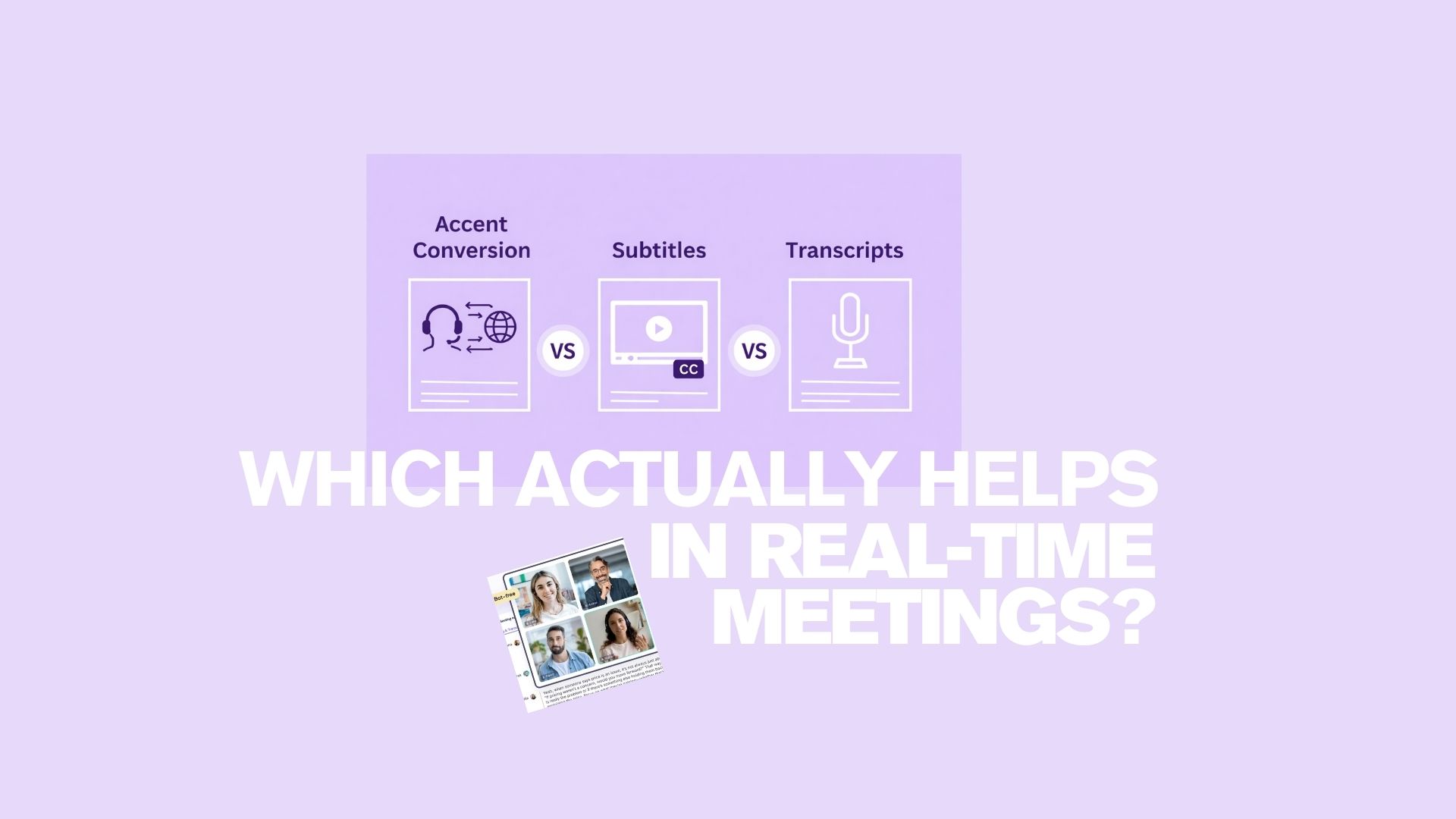
AI is now used to support communication in real time. AI-powered transcription services display spoken words as text, helping listeners follow conversations even when pronunciation differs from what they expect. This reduces the need for repetition and interruption.
A newer direction goes beyond transcription: instead of only displaying speech as text, systems can improve how speech is understood during live conversation.
Emerging real-time AI systems are expanding beyond recognition to actively support clearer communication across accents. Krisp’s AI Accent technology takes a two-sided approach: it can enhance incoming speech for listeners (Listener Mode AI Accent Conversion), and it can adapt outgoing audio via Speaker Mode AI Accent Conversion—helping teams understand one another more easily in real time while preserving the speaker’s natural voice and meaning.
Unlike traditional tools that only transcribe speech, this real-time voice processing operates directly on live audio during conversations. The goal is not to standardize or erase accents, but to reduce listening effort and improve comprehension in global meetings and cross-regional communication.
In language learning, AI supports pronunciation coaching and accent training tools. These systems analyze speech and give feedback on sounds, stress, and intonation. Modern tools focus on clear, intelligible speech rather than forcing learners to adopt a single native accent.
Accessibility and inclusion
Accent-aware technology improves accessibility. It helps non-native speakers, people with hearing loss, and participants in multilingual settings communicate more easily. By reducing listening effort and transcription errors, AI supports more inclusive communication technology.
What comes next
Future accent technology will focus on fairness and personalization. The goal is not to erase accents, but to help people understand one another better across linguistic differences.
Conclusion
Accents are a normal outcome of how language is learned, shared, and changed over time.
Accents reflect history, culture, and social connection—not intelligence or correctness. As communication becomes more global, technology is starting to help: AI-driven speech recognition and real-time accent-aware tools can reduce misunderstandings and make conversations easier to follow. For teams navigating diverse accents daily, Krisp’s AI Accent Understanding technology is beginning to make real-time clarity possible.
FAQ: Accents Explained
People have different accents because language develops through a mix of early learning, social interaction, and historical change. Children learn pronunciation from the people around them, especially peers. Over time, geography, social identity, and linguistic variation create stable accent differences within communities.
Accents come from long-term patterns of language use shaped by geographic separation, migration, and contact between languages. Historical sound changes and local speech norms become established and are passed from one generation to the next, forming regional and social accents.
Accents are learned, not genetic. While biology affects how humans produce speech sounds, the specific accent a person has depends on their linguistic environment during childhood. This is why children adopt the local accent even if their parents speak differently.
People can modify their accent, especially with long-term exposure to a new speech community. However, complete accent loss is rare. Early-acquired pronunciation patterns tend to remain stable, particularly those learned during childhood.
AI recognizes different accents using automatic speech recognition systems trained on large and diverse speech datasets. The more accent variation included in training data, the better AI systems can handle regional and non-native pronunciation differences.
Yes. Some tools improve accent understanding through transcription, while newer systems enhance live audio in real time. For example, Accent AI technology can clarify incoming speech and adapt outgoing audio for better intelligibility, reducing listening effort in global conversations while preserving the speaker’s natural voice and meaning. Other AI tools also support clarity in meetings—such as noise cancellation to remove background distractions, as well as AI meeting assistants and AI note takers that generate transcripts, summaries, and action items. Together, these technologies help teams stay aligned even when speech patterns, audio quality, or pace vary.